Amidst Supply Chain Transformation, Siemens International Logistics Launches Comprehensive Transformation

Having traversed half a century, Siemens International Logistics is gradually transforming from a traditional sea and air freight forwarder into an integrated logistics service provider.

Faced with the global supply chain restructuring and digitalization wave, Siemens continues to promote organizational restructuring, system integration, and data-driven management, and has introduced a Business Unit (BU) system to improve the group's operational efficiency and decision-making capabilities.

Chairman J.J. Hwang pointed out that the core of enterprise digital transformation is not just AI tools, but data integration and process standardization. Through the Workflow system and data platform construction, the company is gradually moving from experience-based management to a data-driven management model.

In recent years, Siemens has also actively expanded into areas such as cold chain logistics, medical transportation, and cross-border e-commerce, continuously improving its international logistics integration capabilities and building a globally competitive logistics brand.

Photos provided by photographer Lai Jianhong.
2026/05/15 by Chang Wan-shan
Restructuring the Organization Amidst Supply Chain Transformation: Siemens International Logistics Towards Integrated Logistics Services
By Chang Wan-shan, Photography by Lai Chien-hung, Images Provided by Siemens International
Trade Magazine, 2026.5, Issue 419, pp. 30–33
Having traversed half a century, UT Group is undergoing a complete transformation. With the second generation hand over management, this long-established logistics company, deeply rooted in sea and air freight, continues to strengthen its innovative momentum and digital transformation, building a globally competitive logistics system from service quality to overall operational efficiency.
UT Group Chairman J.J. Hwang officially took over in 2023, but he doesn't see himself as simply a second-generation successor. Huang believes that "succession" is more like inheriting and continuing the legacy of the previous generation. His expectation is to rethink the company's future direction based on the existing foundation and lead the group into the next 50 years. Therefore, he interprets it as "taking over," rather than simply a second-generation successor. After taking over, he frankly admitted that he faced considerable challenges. Besides changes in the external market environment, the internal organization also faced pressure to adjust.
Chairman Hwang made several adjustments to the existing business model. In terms of organizational structure, he first established a holding company to allow assets to operate independently. Simultaneously, in response to changes in operational efficiency and the regulatory environment, he merged the three companies originally belonging to air freight, sea freight, and customs clearance and inland transportation, unifying them under the umbrella of UT Group. After the merger, the group further introduced a "BU (Business Unit) system" as a new management model. Compared to the more centralized management structure of the past, the new operating method breaks down the organization into multiple business units based on business nature and market division, each responsible for its own operations and performance. Each business unit is no longer just a task-executing unit, but is responsible for its own revenue and results, and must be closer to frontline needs in everything from strategic planning to market response.
It's an Inheritance, Not a Succession: The Reform Path of the Second Generation
The new management model is almost entirely different from the past practices. Chairman J.J. Hwang stated that these changes brought challenges during the implementation process. He not only faced pressure from his father, but the team also encountered difficulties adapting to the new system. He recalled that after returning from the "Xuanzang Road Gobi Challenge" in 2024, he learned from his legal department head that his father, who had then become a supervisor, had expressed differing opinions about his role as chairman. This was a major shock for Chairman J.J. Hwang, who had just taken over the group. Under the dual pressure from the previous generation and his internal team, he spent a sleepless night.
In the early hours of the morning, he turned on the television. It was during the 2024 Paris Olympics, and the badminton men's doubles gold medal match was being broadcast. National badminton players Wang Qilin and Lee Yang were battling it out on the court. During the match, Wang Qilin lost his balance during a return shot and fell to the ground, but still managed to grip his racket and return the ball. That scene remains unforgettable for J.J. Hwang. "Even when you're already on the ground, you still fight so hard, refusing to give up." At that moment, he suddenly realized that his situation was similar to that of a player on a sports field. Although his rhythm was disrupted and the situation was unfavorable, the game wasn't over, so he shouldn't give up easily. This experience also helped him to be more certain of his direction when pushing forward various reforms later. The next day, he immediately convened his core management team, clearly explaining what he needed to do, the direction he wanted to push forward, and the next steps. He first gained the team's understanding and approval, and then pushed forward the reforms according to the established pace, ultimately gaining his father's approval as well.
The Inspiration from the Gobi Challenge: Establishing Goals Makes Direction Clear
"Set the goal first, then work backward to figure out how to do it." J.J. Hwang shared his management experience, saying that goals should be determined before taking action. Therefore, every time he holds a meeting to discuss a project, he asks the team, "Where is the goal?" In his view, many times the problem isn't a lack of methods, but rather a lack of focus from the beginning. Therefore, during meetings, people often raise various problems they encounter, getting stuck on this or that, and eventually the focus shifts away. J.J. Hwang always brings everyone back on track, asking the most fundamental question: What is our goal?
Once the goal is established, the direction gradually becomes clear. J.J. Hwang uses the Gobi Desert Challenge as a metaphor for management. "No one would be foolish enough to run into the desert and trek over 100 kilometers in high temperatures, gravel, and camel thorns. But with a goal, the course naturally emerges." Without a clear goal, it's difficult to sustain long-term action; once the goal is established, the direction gradually becomes clear. Huang Jihui extends his Gobi Desert Challenge experience and thinking to business management, first clarifying the goal, then determining priorities and resource allocation. UT Group's reform path has a clear pace of implementation. As the strategy was gradually implemented, Huang Jihui successfully led the group to turn the tide after taking over, with operations continuing to improve in recent years, maintaining an annual revenue growth rate of over NT$100 million each year.
Key to Successful Digital Transformation: Building Team Consensus First
In driving digital transformation, UT Group has considered it one of its core internal projects in recent years. With the rapid development of AI technology, the demand for data integration and information optimization has increased simultaneously. The group has also incorporated related work into its mid-term development goals, with a two-year timeframe for overall system upgrades.
A key step is completing the integration of the entire group's operating systems and further establishing a data platform. J.J. Hwang believes that AI is not a tool that can be directly implemented, but must be built on a data foundation; how to organize the information previously scattered across various processes and systems has become a more pressing issue.
After completing system integration, Siemens International Transportation did not rush to implement AI, but instead began by optimizing operating processes. Unlike traditional "workflow" designs that require additional data input, the new system directly integrates existing performance indicators into daily processes, avoiding increasing the operational burden on frontline staff. Taking air freight as an example, due to extremely high time requirements, the system uses a game-like interface to display the progress of various operations and automatically prioritizes urgent shipments. This allows both staff and supervisors to view priorities and the overall status on a single screen, reducing the time cost of querying each shipment individually.
J.J. Hwang also pointed out that the most common reason for failure in digital transformation lies in whether the team understands the direction. "If everyone doesn't know why they're doing it, they'll definitely encounter resistance." Therefore, establishing consensus and ensuring the team understands the goals and benefits is one of the keys to successful digital transformation.
Understanding Customer Needs and Providing Complete Solutions
Faced with the ongoing restructuring of global supply chains, J.J. Hwang believes that logistics companies are now truly competing not just on transportation capacity, but on comprehensive integration capabilities. He is not in a hurry to expand overseas locations. "I won't go global just for the sake of globalization." With over fifty years of experience, Siemens International Logistics has accumulated a solid market foundation and currently has long-term partners in Japan, the United States, the United Kingdom, Vietnam, and Malaysia.
Compared to pursuing a large number of overseas branches, Siemens emphasizes the effectiveness of existing partnerships. Through mutual cooperation and coordination, they aim to streamline operations, optimize resource utilization, enhance overall competitiveness, and secure more advantageous cooperation terms.
"No matter how the situation changes, the first priority is always understanding what our clients need," said J.J. Hwang. He explained that as some manufacturing capacity shifts from mainland China to Southeast Asia, logistics demands are no longer limited to simple exports but include transportation from mainland China to Southeast Asia, extending to local warehousing and downstream distribution. For those prepared, this is not a problem but a new opportunity. He also pointed out that the logistics industry today is no longer simply about booking agents but about providing complete solutions based on clients' supply chain issues.
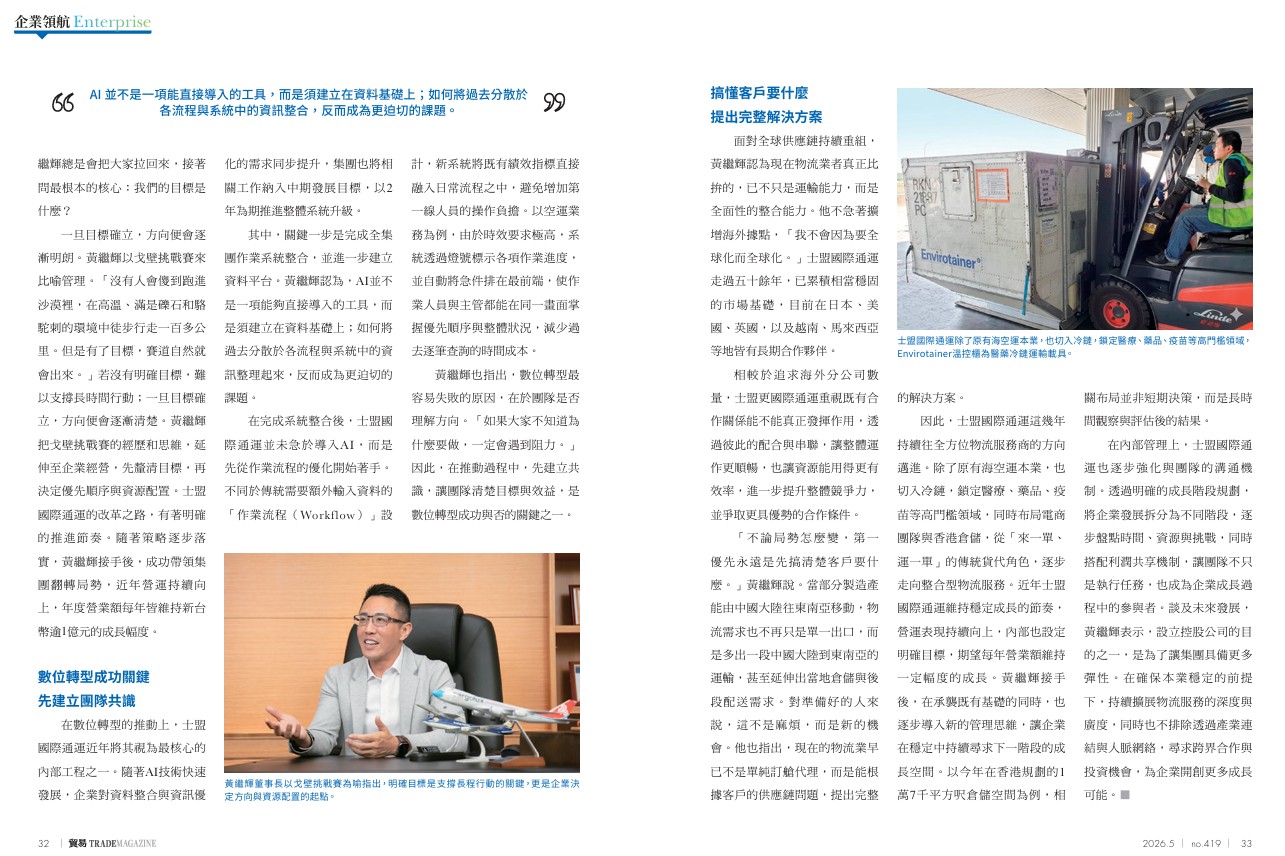
Therefore, UT Group has been continuously moving towards becoming a comprehensive logistics service provider in recent years. In addition to its core sea and air freight business, it has entered the cold chain sector, targeting high-barrier areas such as medical, pharmaceutical, and vaccine industries. Simultaneously, it has established e-commerce teams and Hong Kong warehousing, gradually transforming from a traditional freight forwarder role of "one order, one shipment" to an integrated logistics service provider. In recent years, Siemens International Logistics has maintained a steady growth pace, with its operational performance continuously improving. Internally, it has set clear goals, aiming to maintain a certain level of annual revenue growth. Since J.J. Hwang took over, while inheriting the existing foundation, he has gradually introduced new management thinking, allowing the company to continuously seek the next stage of growth while maintaining stability. For example, the 17,000 square feet of warehouse space planned in Hong Kong this year was not a short-term decision, but the result of long-term observation and evaluation.
In terms of internal management, UT Group has also gradually strengthened its communication mechanisms with its team. Through clear growth stage planning, the company's development is broken down into different stages, gradually assessing time, resources, and challenges. This is coupled with a profit-sharing mechanism, allowing the team to not only execute tasks but also become participants in the company's growth process. Regarding future development, J.J. Hwang stated that one of the purposes of establishing a holding company is to give the group more flexibility. While ensuring the stability of its core business, it will continue to expand the depth and breadth of its logistics services, and will not rule out seeking cross-industry cooperation and investment opportunities through industry connections and networks, creating more growth possibilities for the company.
________________________________________
**Introduction (Split Page)**
AI is not a tool that can be directly imported; it must be built upon a foundation of data. Integrating information previously scattered across various processes and systems has become a more pressing issue.
**Company Information Box | UT Group**
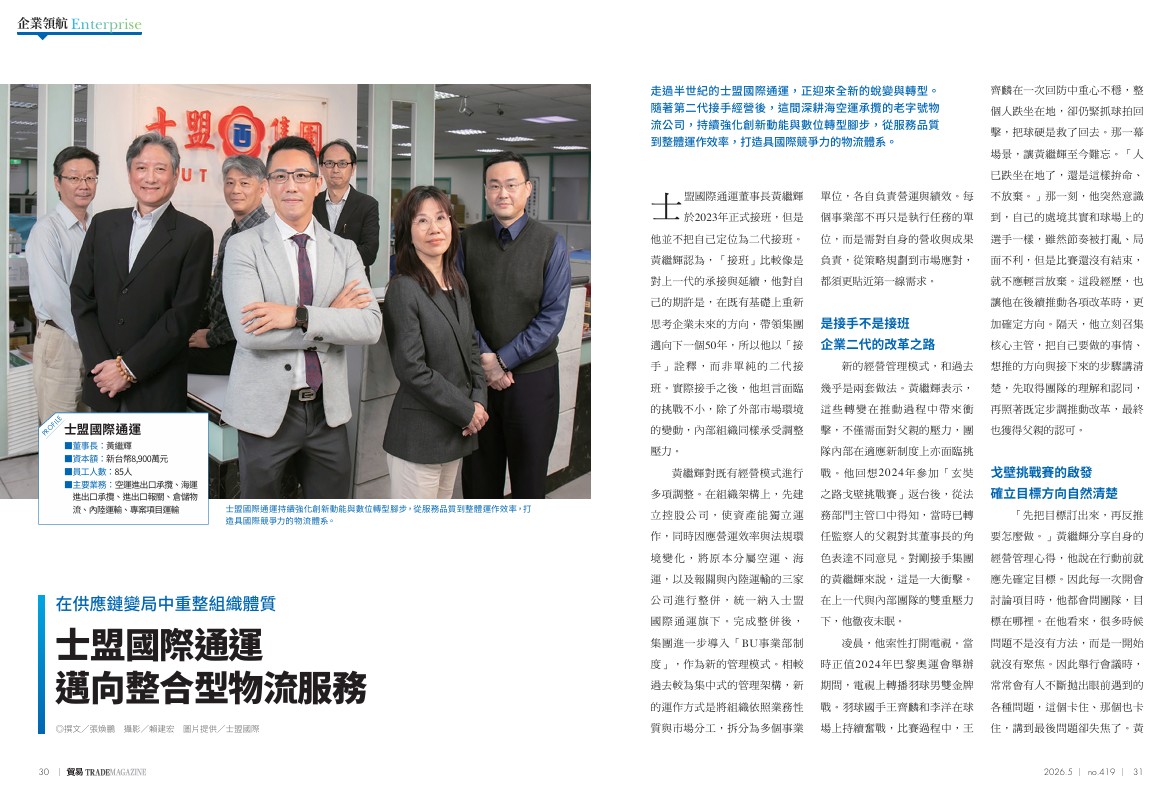
• Chairman: J.J. Hwang
• Capital: NT$89 million
• Number of Employees: 85
• Main Businesses: Air freight import/export, sea freight import/export, import/export customs clearance, warehousing and logistics, inland transportation, specialized project transportation
**Image Descriptions**
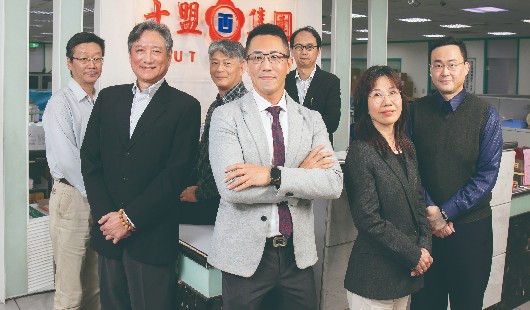
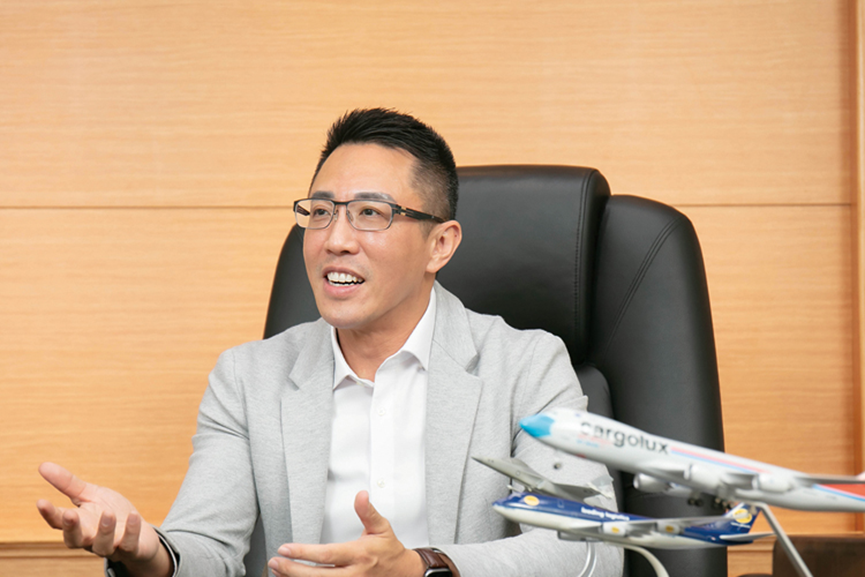
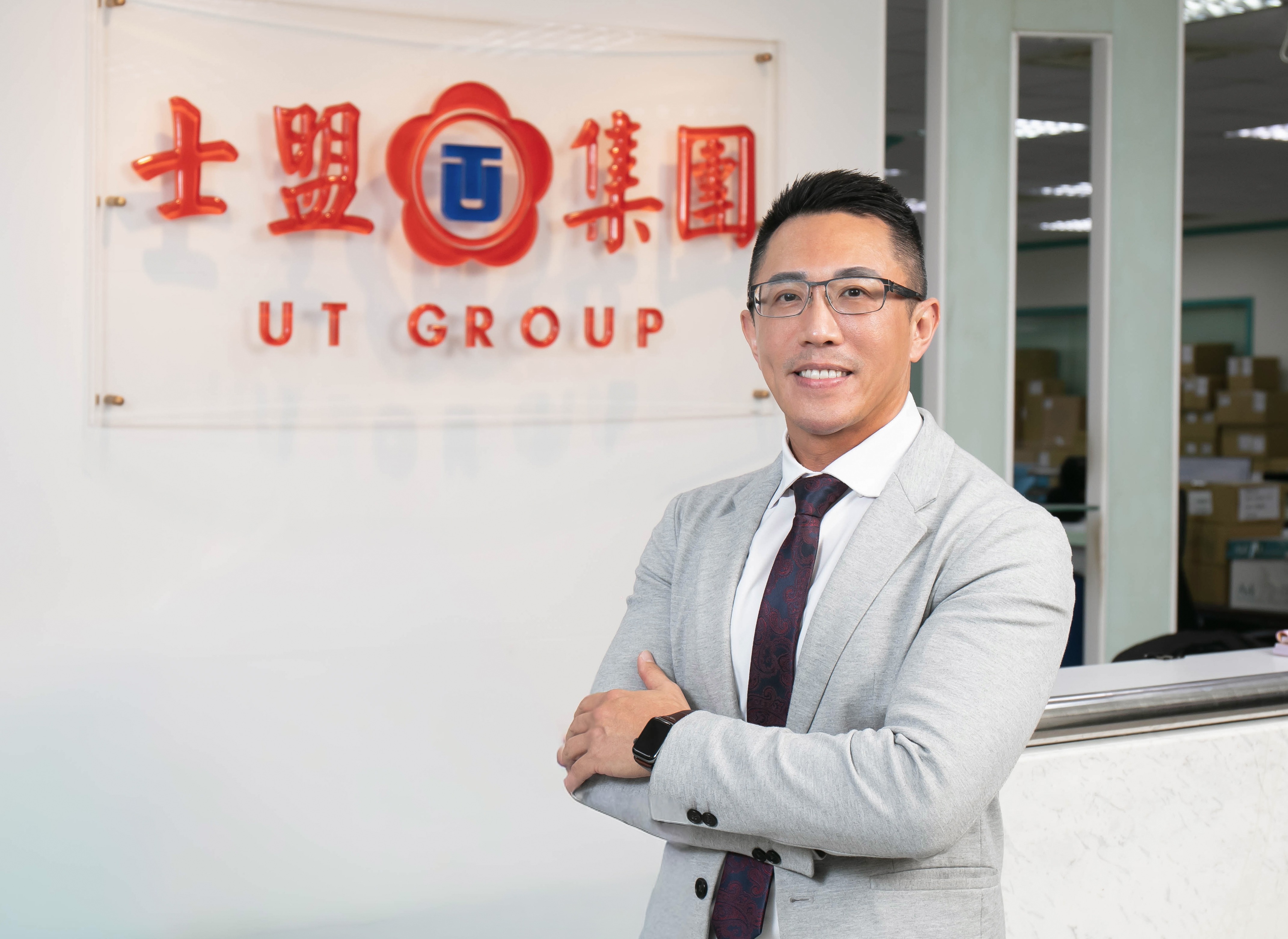
1. UT Group continues to strengthen its innovation momentum and digital transformation, building an internationally competitive logistics system from service quality to overall operational efficiency.
2. Chairman J.J. Hwang used the Gobi Desert Challenge as a metaphor, pointing out that clear goals are key to supporting long-term operations and are the starting point for companies to determine direction and resource allocation.
3. In addition to its original air and sea freight business, UT Group has also entered the cold chain industry, targeting high-barrier sectors such as medical, pharmaceutical, and vaccine industries. Envirotainer temperature-controlled cabinets are used for cold chain transportation of pharmaceuticals.
STAFF
Site Under Construction, coming soon